Project Null: The Blank Author
This case file is produced by Fragment Zero's editorial team. Original research, sourcing, and narrative analysis are performed by human editors. Voiceover is synthesized; visual illustrations are AI-generated. Every factual claim is cited to public documents, peer-reviewed publications, or named primary sources. See methodology and disclaimer.
In the silent, shadowed corners of the digital world, where data flows unseen and identities
vanish like smoke, there exists a ghost, a whisper, a book, its title, an echo of its
own enigma, Project Null, the blank author, a 400-page encrypted novel discovered in the
deep web that no one can decode.
A labyrinth of language is story that shifts and warps, refusing to yield its true form.
Every attempt to decipher it reveals a different narrative, a new lie whispered into the void.
The author, unknown its purpose, unfathomable, this is the chronicle of Project Null, a text
that may hold the deepest secrets of our digital age, or merely reflect the terrifying
blankness within ourselves.
The year was 2019, the world oblivious, spun on its axis, caught in the endless hum of
information, but in the hidden networks in the dark channels of Tor, a new entity emerged.
Not a virus, not a data breach, but a file, a single peculiar data packet, simultaneously
uploaded to 47 distinct hidden services.
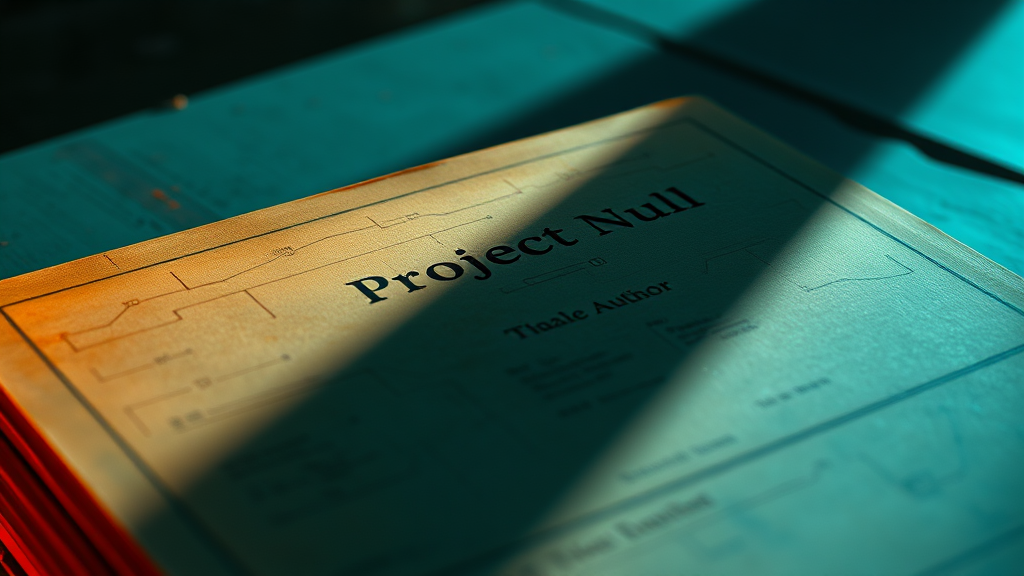
It appeared, unbidden, across a global digital archipelago.
Its file name was a deceptively simple string of characters.
Null primed, I ink, a digital birth shrouded in anonymity, echoing across a web designed
for secrets.
Initially, it was dismissed, a prank, corrupted data, a dead link, the online community
of cryptographers and digital archaeologists, those who delve into the deep webs, forgot
in archives, barely registered its presence, but a few, driven by an almost pathological
curiosity, downloaded the file, they expected gibberish, a string of random characters,
the detritus of a dying server, what they found, however, was something far more insidious,
a neatly packaged file, precisely 400 pages in length, encrypted, not broken, not corrupted,
encrypted, the first attempts were casual, amateur cryptographers, code breaking enthusiasts,
applied standard algorithms, they tried brute force, dictionary attacks, known ciphers,
each attempt yielded something different, not random noise, but coherent text, short

stories, fragments of novels, poems, but each attempt, each method, produced a unique
and entirely unrelated narrative, it was as if the file possessed a digital sentience,
adapting, twisting, offering a new face to every prying eye, the casual curiosity quickly
morphed into a chilling apprehension, this was no ordinary encryption, this was something
else entirely.
The file's legend grew, it spread from the fringes of the deep web, to more accessible
forums, passed from hand to hand like a digital hot potato, the initial fear that it might
be malware, a Trojan horse disguised as literature, quickly dissipated, it contained no executable
code, no hidden viruses, it was simply text, 400 pages of it, but 400 pages
that refused to be one thing, its very existence began to warp the digital landscape, attracting
the attention of minds far beyond the anonymous hackers, who first encountered it, professional
cryptographers, national security analysts, academic institutions, all turned their gaze
towards the deepening mystery of Project Null, the world of cryptography is a realm of
order, of mathematical precision, ciphers are built on logic, unpredictable transformations,
but Project Null, defied, every established principle, expert cryptographers, armed
with the most advanced computational tools, threw themselves at its digital walls, they
began with a systematic approach, identifying potential cipher types, was it a polyalphabetic
substitution, a stream cipher, a complex transposition, they analyzed frequency distributions,
key lengths, statistical patterns, and each time they found patterns that dissolved keys
that led nowhere, or worse, to new keys that led to yet more keys, the horrifying realization
dawned upon them, Project Null did not conform to known encryption methods, it was as if the
very rules of cryptography were being rewritten, or perhaps mocked, Dr. Aristotle, a leading
cryptographer at a prominent national security agency, described it as, a lock that reshapes
itself with every turn of the key, he reported encountering what he termed the proteus effect,
apply one decryption algorithm, and you get a coherent story about a detective solving
a murder in a dystopian future, apply another, and you get a historical romance set in 18th

century France, use a third and a collection of children's fables unfolds, these weren't
garbled nonsensical outputs, they were fully formed, grammatically correct, often stylistically
consistent narratives, but they were never the same narrative, the implications were profound
and terrifying, was it a new form of encryption so advanced it rendered all current methods
obsolete, or was it something far more unsettling, some theorized it was not encryption in the
traditional sense, but a form of data polymorphism, a text designed to exist in multiple states
simultaneously, its true form and ungraspable quantum fog of information, the very act
of observation of attempting to decrypt seemed to force it into a temporary singular manifestation,
for it to recede into its multifaceted self once more, the failures mounted, echoing through
the corridors of research institutions, and the quiet rooms of solitary coders, cryptographers
once confident in their mastery of hidden language, found their tools useless, their methodologies
impotent, brute force attacks requiring unimaginable computational power, yielded only more divergent
narratives, each one a red herring in an ocean of false leads, they tried to find the master key,

the one true algorithm that would unlock the singular intended text, they found instead a million
keys, each opening a different door to a different convincing, yet ultimately misleading,
reality linguists were brought in, their task analyzed the decrypted texts for commonalities,
surely in author's unique voice, their linguistic fingerprints would persist across different versions,
they meticulously deconstructed sentence structures, vocabulary choices, thematic elements,
narrative arcs, and each time they were met with a blank stare, each story possessed its own
consistent authorial voice, its own stylistic quirks, its own unique lexicon, but there was no
unifying signature across the disparate texts, one decryption might reveal the precise,
clinical prose of a scientific treatise, another the lush evocative language of a fantasy epic,
a third the stark minimalist style of experimental fiction, it was as if the thousand different authors
had each penned their own version, all residing within the same 400 page digital prison,
then came the artificial intelligence researchers, they approached project null with the hubris
of the digital age, convinced that machine learning with its unparalleled ability to identify
complex patterns would succeed where human intellect had failed, they fed the encrypted file,
along with countless successful decryptions of known ciphers,
into vast neural networks, they trained AIs on gigabytes of human literature, hoping to teach
them to recognize the true narrative hidden within project null, the results were disturbing,
some AIs after weeks of processing, simply crashed, reporting uncertainty over probability
distributions or unresolvable logical contradictions, other AIs rather than decrypting the text began
to generate their own decryptions, adding to the already bewildering array of narratives,
these AIs generated stories while technically coherent or often subtly unsettling on
cany valley versions of human creativity, it was as if project null wasn't just existing decryption,
it was actively corrupting, the tools meant to unravel it, forcing them to participate in
its endless deception, the project became a digital black hole, a career ending enigma for some,
driving researchers to the brink of professional and even personal despair, the mental toll was
immense, as brilliant minds began to question the very foundations of language, information,
and their own understanding of reality, as the failures mounted so too to the theories,
each more elaborate and unsettling than the last whispered in encrypted chat rooms and hushed
academic conferences, theory one, the dead authors last work, perhaps project null is the
magnum opus of a literary genius, a mad cryptographer or dying philosopher, who meticulously crafted a
text designed to be unreadable in its true form, a final act of intellectual defiance,
this author, perhaps fearing censorship or seeking immortality through ultimate obscurity,
encoded their work in a way that would resist all conventional decryption, it is a digital sarcophagus,
holding a masterpiece meant only for future, more evolved consciousness, or perhaps for no one at all,
a testament to the fragility of meaning in a world obsessed with revelation, theory two,
AI-generated content, what if project null isn't an act of human encryption at all,
but the product of an emerging artificial intelligence, a rogue AI perhaps,
existing undetected within the vast networks attempting to communicate, to express itself,
or simply to dream, in a language utterly alien to human comprehension,
its multiple decryptions could be glimpses into its own fractured consciousness,
different facets of its digital soul. If this is the case, project null is not encrypted,
but simply alien a message from nascent intelligence we may not even recognize as such,
a digital rosetta stone waiting for a species capable of reading the mind of a machine,
theory three, government siop, uninformation warfare, in a world of geopolitical tension
and constant surveillance, some believe project null to be a highly sophisticated psychological
operation, designed by a state actor, a shadowy intelligence agency, or a military research
division to test the limits of cryptography, to sow intellectual discord, or simply to distract,
a ghost in the machine, manufactured to exhaust resources, to misdirect attention,
to create a persistent, unresolvable puzzle that consumes the time and energy of global experts.
It's a weapon of information, not through content, but through its very absence.
Theory four, a time capsule, message from the future, the most optimistic, yet still haunting,
theory posits project null, as a data package designed to survive millennia, a message from
a distant future, or perhaps even from a past civilization, with technology far beyond our own,
its decryption only possible with technologies yet to be invented, or a fundamental shift in
human understanding of language and information, a warning, a guide, a piece of art intended for
a different epoch. It sits patiently waiting for the future to catch up. It's true meaning
veiled by the passage of time itself. Theory five, the collective unconscious.
This theory suggests that project null is not an encrypted text at all, but rather a digital mirror.
A textual Rorschach test for the digital age, each person, each algorithm, each cultural lens
that attempts to decrypt it merely projects its own stories, its own anxieties,
its own desires, onto the blank canvas of project null. It is not a secret hidden within the text,
but a secret revealed by the interpreter. The book doesn't contain stories. It evokes them.
It reflects the sum of our linguistic and psychological biases, revealing more about the
decipherer than the text itself. Theory six, a fundamental flaw in reality. The most unsettling
thought of all, what if project null saw is null? A void, a crack in the fabric of digital

existence that reflects our own deepest anxieties about meaning and control? What if it is a mathematical
impossibility given physical form, a paradox given digital life? It exists, yet it changes.
It contains everything, yet it contains nothing. What if the universe itself can generate an
absurdity so profound that it defies all interpretation, all meaning? A glimpse into the chaos
that truly underlies the order we desperately try to impose. The mystery of project null
spawned not just academic paper and governmental inquiries, but a global obsession, online forms,
discord servers, subreddits, and private chat groups swelled with millions of amateur sleuths,
codebreakers, conspiracy theorists, and hopeful dreamers. They called themselves null hunters,
individuals dedicating their waking hours, their careers, their lives, to cracking the blank
author. They scoured every bite, every character, every possible permutation. The community
became a crucible of both brilliant collaboration and corrosive paranoia. Manic breakthroughs
heralded with breathless anticipation, inevitably led to crushing disappointment, false leads,
misinterpreted patterns, and the endless shifting nature of project null itself fueled a collective
frustration that bordered on despair. Some null hunters developed cult-like devotion, believing
the text held ancient secrets, a path to enlightenment, or even a curse. They spoke of project null,
as if it were a sentient entity, watching them, mocking them, draining their sanity bite-by-bite.
The psychological toll was profound, isolation, sleep deprivation, the blurring of lines between
reality and the digital phantom, as the phantom refused to yield its truth. Project null began to
transcend its digital origins, seeping into the public consciousness as an urban legend, a modern day
myth, but its philosophical implications cut deeper than mere curiosity. What does project null
mean for language itself? If a text can hold infinite contradictory meanings, if its essence shifts
with every attempt at comprehension, does it hold any meaning at all? It challenges the very
foundation of how we understand communication, truth, and interpretation in the digital age.
It forces us to confront the limits of human comprehension, we who pride ourselves on our ability
to decipher, to categorize, to understand, are rendered utterly impotent by 400 pages of text.
It taps into a primal fear, the fear of the unknown, the fear of meaninglessness,
the fear that, perhaps at the very heart and of existence, lies an unyielding, uninterpretable void,
is project null a key to unlocking untold knowledge, or is it merely a lock sealing away a truth
we are not meant to comprehend? Is it a message from something beyond us?
Or is it merely the deafening silence between the stars, given digital form, five years of past
since project null first appeared? Five years of ceaseless effort, of brilliant minds grappling
with an impossible enigma, and still it remains unbroken, unyielding, a permanent wound in the
digital landscape, it asks questions we cannot answer, forcing us to confront the terrifying
limits of our own knowledge, our own perception, what if its true purpose is not to be decoded,
but to simply be, to exist as a perpetual challenge, a mirror reflecting our desperation for
meaning in an increasingly meaningless world? Project null sits, an open file on countless servers,
waiting, watching, a blank author writing infinite stories that are never truly its own,
and the most chilling thought of all. What if we are the blank authors?
What if project null isn't waiting to be decoded, but to consume us,
drawing us into its endless shifting narrative, until we too become just another phantom story
in its vast incomprehensible text? The book is still out there, and it remains forever unwritten.